Noticias
Members Calling #156 | Arantxa Acosta: “The best solutions emerge when the entire organization thinks together”
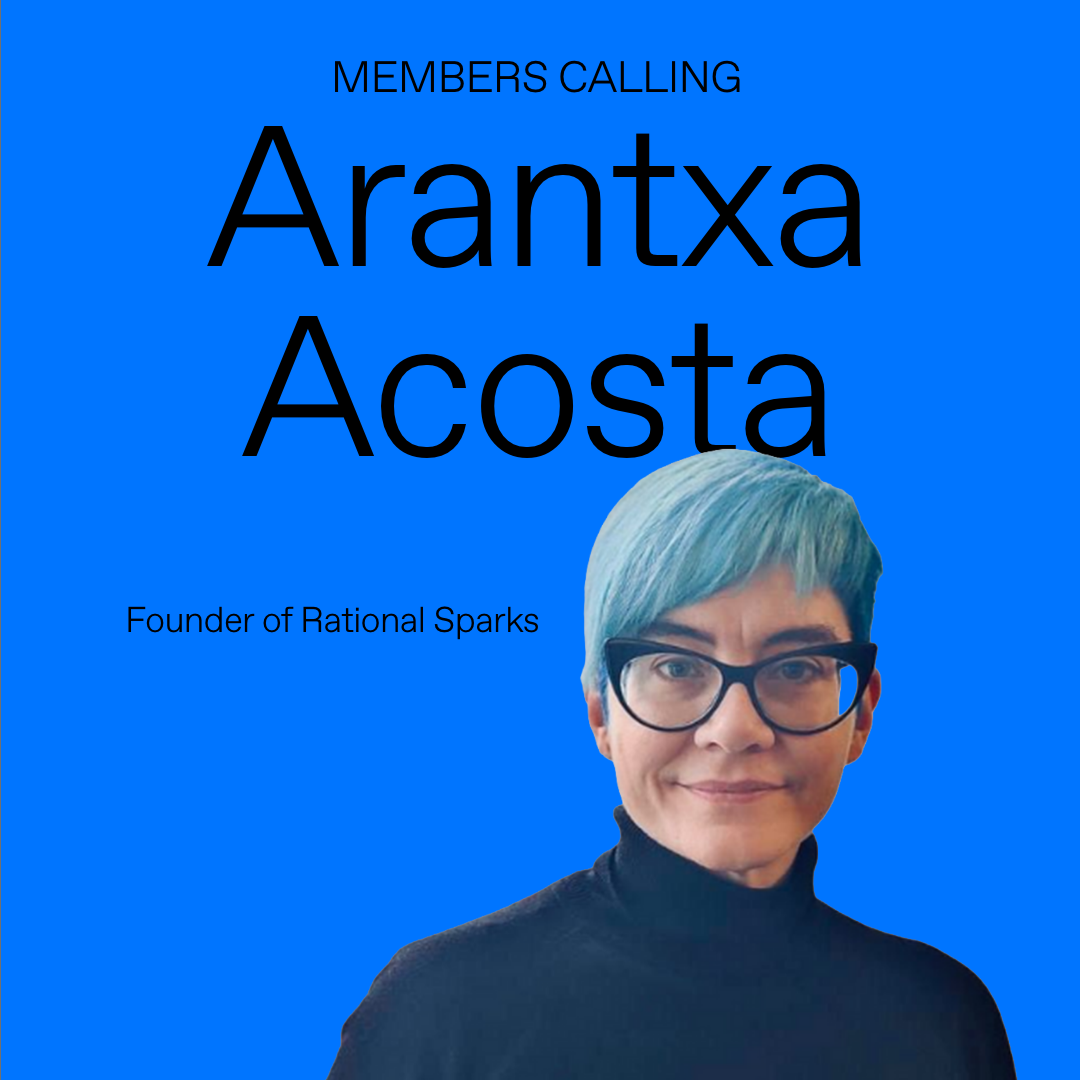
On the website of the consultancy Rational Sparks, you can read: “We help you find creative solutions based on data, but also on the team’s emotion, energy, and creativity. Using cutting-edge technology or post-its, but always with imagination, enthusiasm, and proven data.”
Data and emotions. Analysis and sensitivity. Creating projects that combine these dimensions requires versatility. And Arantxa Acosta (Barcelona, 1977), its founder, has it: a chemical engineer, EMBA from ESADE… and a master’s degree in film criticism. “Three” sides of the same coin.
She defines herself as a “Strategic Designer, Applied Thinker, and Organizational Agitator.” And she explains why.
TB: What is the purpose of your project?
AA: To help organizations (startups or large, established companies) become self-sufficient in turning complex and ambiguous challenges into action plans in record time, activating internal talent through disruptive methodologies, traditional tools, and AI.
TB: Where is your project now and where do you see it in two years?
AA: Growing as a boutique transformation consultancy based on preferred futures. In two years, consolidated as a benchmark in exploring emerging signals and patterns together with our clients, connecting them with tools, imagination, and sensitivity to move forward with clarity and enthusiasm.
TB: A key decision that has shaped your project.
AA: Combining data and emotions. Committing to Futures Thinking and creating the Future Sparks Lab to integrate vision, perception, and possibilities.
TB: What has been the biggest challenge you’ve faced and what has it taught you?
AA: Translating strategic, operational, and emotional complexity into clarity for founders and executives. It has taught me that the best solutions emerge when everyone involved actively participates in the process.
TB: The best advice you’ve received.
AA: “Everyone in a meeting has something to say, regardless of their role or experience.”
TB: We all change over time. Have you changed your mind about anything?
AA: I used to think strategies were designed by leaders. Today, I believe they emerge when the organization thinks together.
TB: A professional role model who inspires you and why.
AA: I’ll mention two: Dr. José Ignacio Latorre, a quantum physicist and author of Ethics for Machines, because he raises the question of what values we will program into them, and Ignacio Martínez Mendizábal, a paleontologist who reflects on what makes us human in these times. These are conversations that apply to the future of organizations.
TB: What do you value most in the people you work with?
AA: Honesty, curiosity, and the courage to question the status quo.
TB: A technology that will shape the future.
AA: Brain-computer interfaces (BCI) are already being researched, enabling direct collaboration between human brains through digital neural networks—something that could transform how we learn, decide, and collaborate within organizations.
TB: A startup or company you admire and why.
AA: For example, Hanson Robotics, which explores how we will interact with AI.
TB: What do you do to disconnect?
AA: Lots of cinema, lots of reading and lots of walking.
TB: A book to recommend.
AA: The Demolished Man by Alfred Bester. Visionary about organizations, power, and telepathy in a hyperconnected society.
TB: A song that defines your current moment.
AA: ‘Feel Good Inc.’ by Gorillaz.
TB: A recipe, a restaurant.
AA: Any creation from Somodó Bá.
TB: A place in the world.
AA: Tokyo.
TB: Where would you invest 100k?
AA: In neurotechnology. Synchron, for example.
TB: If you weren’t an entrepreneur…
AA: I would probably be writing science fiction. Entrepreneurship is a way of “prototyping” those stories in real life.
TB: What is Tech Barcelona to you?
AA: A “future accelerator”: the interconnection of talent, technology, and entrepreneurship to imagine and build, starting now, what once seemed like distant dreams.