Noticias
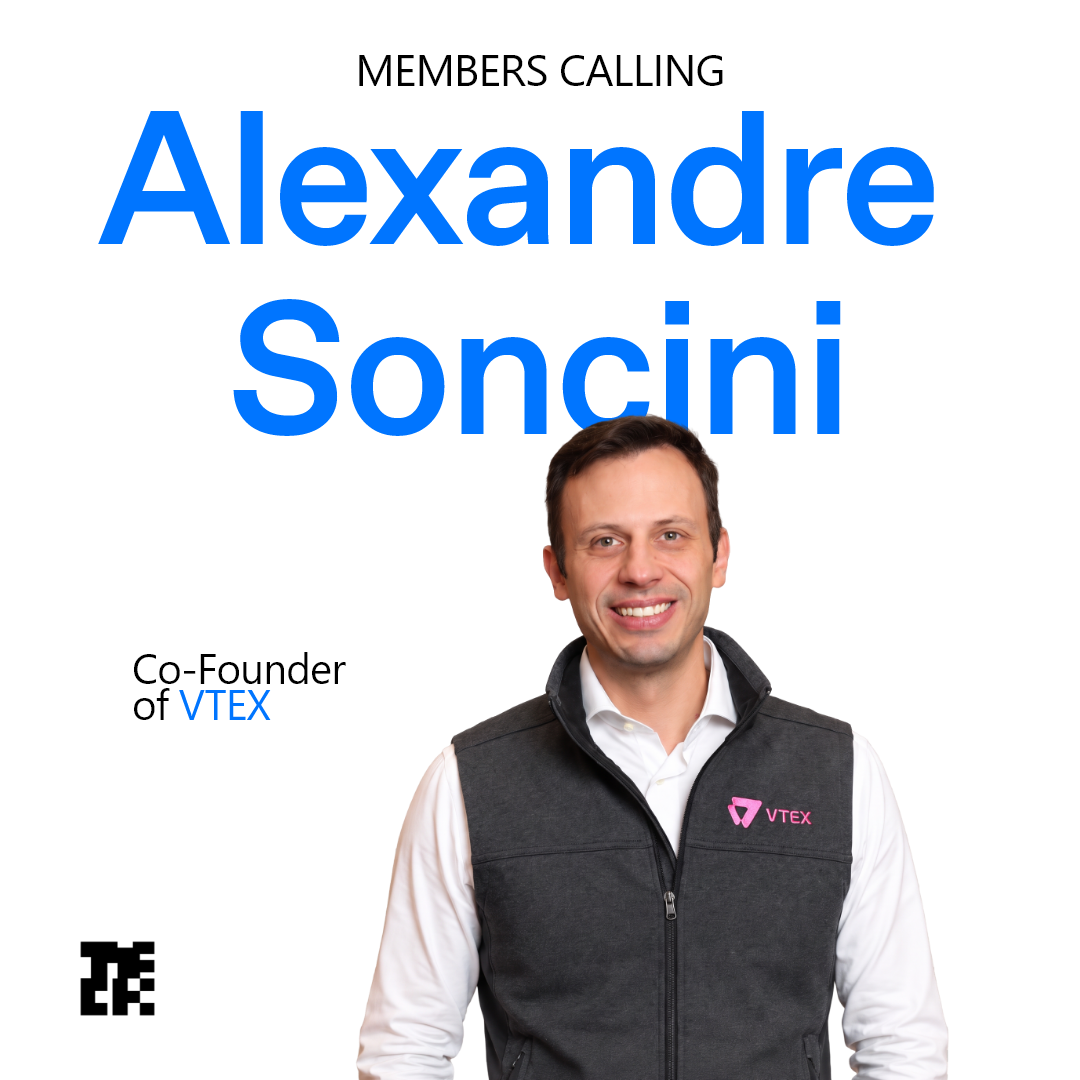
Members Calling #177 | Alexandre Soncini: “You have to be willing to make decisions with just 10% of the information you wish you had”
Buying online seems easy. And for the buyer, it is: all you have to do is visit an online store, click on an eye-catching “Buy” button, and wait for the package to arrive at your door. But behind this apparent simplicity, the company selling the product has to coordinate a much more complex operation. Building and maintaining the online store, managing inventory, handling payments, returns and refunds, coordinating orders, and ensuring delivery. And if something goes wrong, resolving it without compromising the customer experience.
In 1999, the founders of VTEX were already anticipating some of these challenges. Today, the Brazilian company offers a digital commerce platform under the SaaS (Software as a Service) model, is listed on the New York Stock Exchange (NYSE), and operates in 11 countries. Its clients include Walmart, LEGO, Disney, L’Oréal, and Coca-Cola. After beginning its international expansion across Latin America and the United States in 2012, it entered Europe in 2017.
“Barcelona is our base for developing this strategy in Europe,” explains Alexandre Soncini (São Paulo, 1981), co-founder of VTEX, who currently lives in Barcelona. A computer engineer with a master’s degree in project management and a former participant in Harvard Business School’s General Management Program, Soncini reflects on the lessons that have shaped his career, recommends the only management book he ever took notes on, and champions the potential of Latin American technology, which, in his view, remains undervalued.
TB: What is the purpose of your project?
AS: VTEX is a composable commerce platform for enterprise brands and retailers. The purpose is to let large companies run commerce with less complexity and cost: one platform for storefront, orders, marketplace, OMS and now agentic customer experience, so teams ship faster and operate with fewer vendors.
TB: Where’s your project at and where do you see it in two years?
AS: We are a public company (NYSE: VTEX) serving enterprise clients across the Americas and Europe. Looking ahead, I expect more of commerce operations and customer conversations on our platform to be handled by AI agents, with people supervising outcomes rather than executing tasks. Barcelona is our base for the European side of that agenda.
TB: A key decision that has shaped your project.
AS: Going global from Brazil instead of staying a regional leader. It forced us to build for complexity (multi-currency, multi-country, enterprise scale) earlier than was comfortable, and that is what made the IPO possible.
TB: What has been the biggest challenge you’ve faced, and what has it taught you?
AS: The hardest stretch was not the IPO, it was the failed ERP migration before it and the cash flow crisis that followed. It taught me that the cost of a bad decision is not the decision, it is how long you take to admit it. Failing fast is only a virtue if you actually stop.
TB: The best advice you’ve ever received.
AS: “Have the courage to decide with 10% of the information you wish you had”. I picked it up from Ben Horowitz and it has held up better than most frameworks.
TB: We all change over time. What have you changed your mind about?
AS: Where value sits in software. I used to look for companies with a strong interface layer. AI is disrupting exactly that layer, so now I look for assets AI amplifies, first party data above all. What I did not drop is the idea that an opinionated layer on top of a third party model is worth building: fewer tokens, better output, less time.
TB: A professional role model who inspires you and why.
AS: My father. He taught me the values everything else sits on: work hard, take responsibility for what is yours, and own a mistake the moment you see it.
TB: What do you value most in the people you work with?
AS: Ownership and accountability. People who treat a problem as theirs until it is solved, instead of handing it back well documented.
TB: A technology that will shape the future.
AS: Humanoid robots. Once general-purpose robots can do physical work at scale, the cost structure of logistics, retail operations and manufacturing changes as much as software changed services.
TB: A startup or company you admire, and why.
AS: Google. Very few companies manage to reinvent their own business while they are the incumbent, and they have done it repeatedly. Being first is easier than staying relevant.
TB: What do you do to disconnect?
AS: Travelling with my family, outdoor sports and football.
TB: A book to recommend.
AS: ‘The Hard Thing About Hard Things’, by Ben Horowitz. It is the only management book I kept taking notes from, and two of the maxims I live by came out of it.
TB: A song that defines your moment in life.
AS: I listen to a lot of music but I am no expert, so I will not pretend one song defines the moment.
TB: A recipe, a meal, a restaurant.
AS: Pizza, and specifically Pizzaria São Pedro in São Paulo.
TB: A place in the world.
AS: A beach house, with family and friends in it. The place matters less than who is in it.
TB: Where would you invest 100k?
AS: In Latin American tech. The engineering talent in the region is remarkable and the region is still undervalued, which is a rare combination.
TB: If you weren’t an entrepreneur…
AS: Racing driver, if I could afford it.
TB: What does Tech Barcelona mean to you?
AS: The way into the Barcelona tech scene for someone who arrived from abroad: I joined to build my network here, and it works.