Noticias
Members Calling #179 | Natasha Gorobinskaya: “A better future must also include the founders themselves”
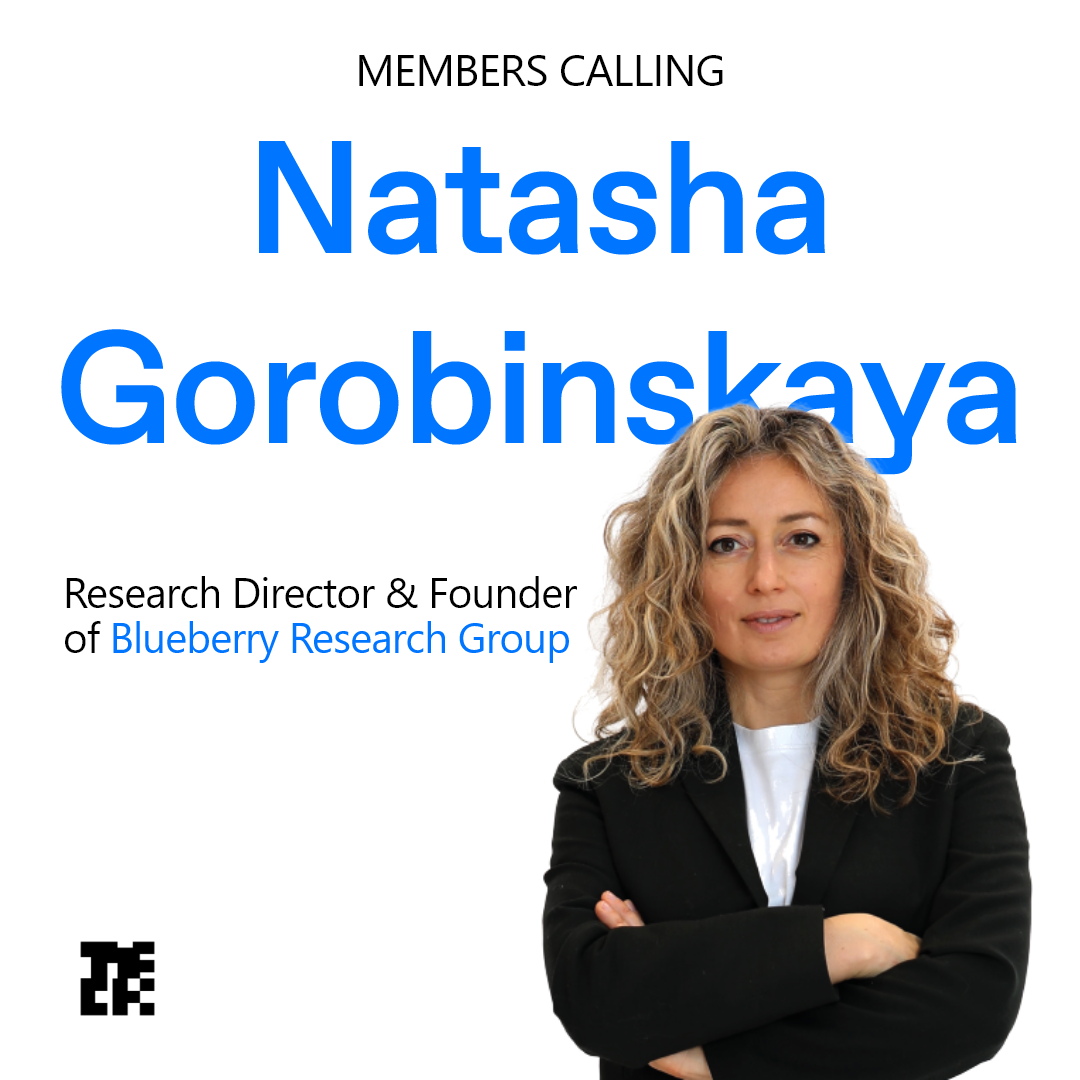
There are people who seek answers, and others who particularly enjoy the journey that leads to them. Natasha Gorobinskaya belongs to the latter group. Her career is a succession of questions, territories to explore and a testament to her curiosity: from her early steps in business development and marketing to user research and human-computer interaction; from Google and Miro to TheFork; and, finally, to founding her own venture, Blueberry Research Group, where she helps founders and teams better understand their customers before setting out to develop their ideas.
Her curiosity doesn’t stop when she closes her laptop. Her bookshelf brings together names such as Rick Rubin and Malcolm Gladwell alongside French literature, as well as her own book, ‘Finding the Fit.’ Drawing and music are two other interests that are part of her everyday life. She enjoys discovering connections, learning from others and seeing what emerges when people think together.
TB: What is the purpose of your project?
NG: I founded Blueberry Research Group to help founders and product teams make informed decisions about what to build, grounded in an understanding of the people they want to help.
It brings together my 25 years of exploring how people make decisions, across academic and business settings. Through research and education, we make customer understanding accessible to companies that don’t have their own research department. Teams can develop practical research skills themselves or work with us to answer specific questions.
Our purpose is “research for a better future”: helping people crystallise their ideas, understand which problems matter to their customers, and turn their intention to help into solutions that improve people’s lives.
TB: Where’s your project at and where do you see it in two years?
NG: Today, Blueberry Research Group is growing through research and mentoring with founders, and partnerships with accelerators. We help teams turn customer understanding into product and growth decisions. An upcoming accelerator workshop, for example, focuses on turning customer insights into solutions.
We’re preparing a 12-week bootcamp bringing founders together with UX researchers and designers, helping early-stage startups validate solutions and scaleups identify where and how to grow.
Our Impact Foundation supports impact-driven startups through research grants, making customer understanding accessible to founders working to improve people’s lives. We help them build evidence to turn that intention into effective solutions.
Over the next two years, I want to expand our team, grants and internships and create the Hive: a nurturing environment for founders, researchers, designers, programme managers, community leaders and other ecosystem members.
The ambition is to unleash our human potential to work together towards a better future. I’d like to find partners for a space in Madrid, accessible at little or no cost, where people with shared purpose and diverse experiences can meet regularly, find a shared creative flow and use their collective intelligence to nurture ideas and solve problems.
TB: A key decision that has shaped your project.
NG: A key decision was to make “research for better futures” the guiding principle of Blueberry Research Group. For me, that means helping founders bring valuable ideas to life with less cost and risk.
It also means nurturing the people behind those ideas. Founders face enormous uncertainty, and their energy is finite. By bringing more structure and customer understanding into their decisions, I want to help them find a clearer path, recognise when to pivot, and develop their ideas with less strain on their well-being. Better futures should include the founders themselves.
TB: What has been the biggest challenge you’ve faced, and what has it taught you?
NG: The biggest challenge has been truly understanding founders’ journeys and finding ways to help that fit their reality. Every founder is different. Behind the confidence and drive they project publicly, there can be uncertainty and a sense of being on their own. Even when I know I can help, the rush and pressure of building a business can leave little room to make that support meaningful.
It has taught me to listen, remain flexible and accompany people rather than push them. You cannot help everyone, but that does not mean you should stop trying. Support has to make sense for the person and their project at that moment.
TB: The best advice you’ve ever received.
NG: The best advice I’ve ever received was to really become the owner of my emotional space. Simply put, emotional control and awareness. It’s the key to effective interaction with the environment around me, whether at work or in my personal life, with family and friends. Being aware of my own emotional state, and whether I’m reacting or responding, is a real treasure.
TB: We all change over time. What have you changed your mind about?
NG: Change has been a constant in my life: I’ve changed environments, countries and occupations. One thing I’ve changed my mind about is doing things on my own. I used to focus on what I could figure out and achieve independently, thinking, “I can do this faster myself.”
Now, I find it really enjoyable to figure things out together with a team of trusted collaborators. That joy of figuring things out together has become a more important motivation for me.
TB: A professional role model who inspires you and why.
NG: Alina Verbinchuk, who was my professional coach, is someone who really inspires me. We’ve stayed in touch for years. She is incredibly smart and daring, and combines a thoughtful approach with the energy to go and do things. She keeps exploring new ways to apply her talents and experience. Seeing her write a book gave me the idea to write my own. I’ve always believed that anything is possible; she makes that belief practical and grounded.
Tim Ferriss and Rick Rubin are also important sources of knowledge and inspiration through their podcasts. Their conversations with incredibly diverse people bring knowledge with immense depth. Tim is more practical, looking for patterns in performance and achieving greatness. Rick, through Tetragrammaton, is more spiritual and unexpected, with a strong focus on creativity. They approach things very differently, and both enrich my life.
TB: What do you value most in the people you work with?
NG: What I value most is attitude: curiosity and a willingness to learn from everything, whether through academic study or the environment around us.
I also value a collaborative, positive attitude. By positive, I don’t mean believing that everything will always be okay. I mean seeing the best in people and situations, recognising opportunities, and seeing every obstacle as a potential door to learning. I appreciate collaborators who ask, “What is the best we can make of this?”
TB: A technology that will shape the future.
NG: Technologies that improve our recycling journey as a species and help us manage waste more effectively.
TB: A startup or company you admire, and why.
NG: I’ve admired Hume AI for years. What impressed me was their work on using emotional cues in the voice to shape a conversation with AI, and the depth of research behind it. I found interacting with their voice interface so gratifying that I actually miss it.
Their work initially resonated with my own research on music, emotions and cognitive performance. What I admire now is the maturity of their approach to interaction: it recognises the emotional nature of the human mind. I believe emotional input will become an increasingly important part of how we interact with AI.
TB: What do you do to disconnect?
NG: My easiest way to disconnect is a long walk in the park with an audiobook. I also enjoy being with friends and having a really good time together, for example when we go skiing. I draw too, though that requires more intention and concentration.
Recently, after years of outsourcing it, I’ve discovered that cleaning my apartment helps me put things in order in my mind. It’s not quite disconnecting, but it’s a way to order my space, inside and out.
TB: A book to recommend.
NG: There are many. ‘The Creative Act’ by Rick Rubin was eye-opening, while also confirming a lot of things for me. Almost all of Malcolm Gladwell’s books have been turning points. I’d also mention ‘Narnia’. And ‘The Great Gatsby’, simply because I love it. It’s so well written.
TB: A recipe, a meal, a restaurant.
NG: Mune, a Lebanese restaurant near my home. I love Lebanese food, and eating there is such a sensual pleasure, especially the little meat pastries. But really, everything is very good.
TB: A place in the world.
NG: Zell am See, in the Alps. I went there last winter with my friends and my son. With the mountains and the lake, it’s so peaceful and absolutely stunningly beautiful.
TB: Where would you invest 100k?
NG: I’d invest in creating a physical community space where the design and atmosphere itself brings peace, collaboration and joy. Somewhere you feel welcome the moment you walk in, free to stay and contribute, but also to be nurtured.
It would be a space for people who like to explore and create. There could be a library, somewhere to have coffee or a meal, events, art exhibitions and stimulating conversations. A place of joy and where people enjoy being together.
TB: If you weren’t an entrepreneur…
NG: If I weren’t an entrepreneur, I’d be doing art. I’d study French literature, draw, make things with my hands, grow things and write.
I also want to create a foundation that promotes art, education, literature and music, and supports research into longevity and optimal human performance. That’s a long-term goal I’m planning to pursue.
TB: What does Tech Barcelona mean to you?
NG: Tech Barcelona is a connection to people with whom we can share thoughts and activities that are an important part of our lives at this point. It has to do with entrepreneurship, but also with an attitude to life, to discovering new paths and building our own future. So, in a way, it’s about like-minded people.