Noticias
Members Calling #180 | Rebeca Kung: “Capital can become a force for progress”
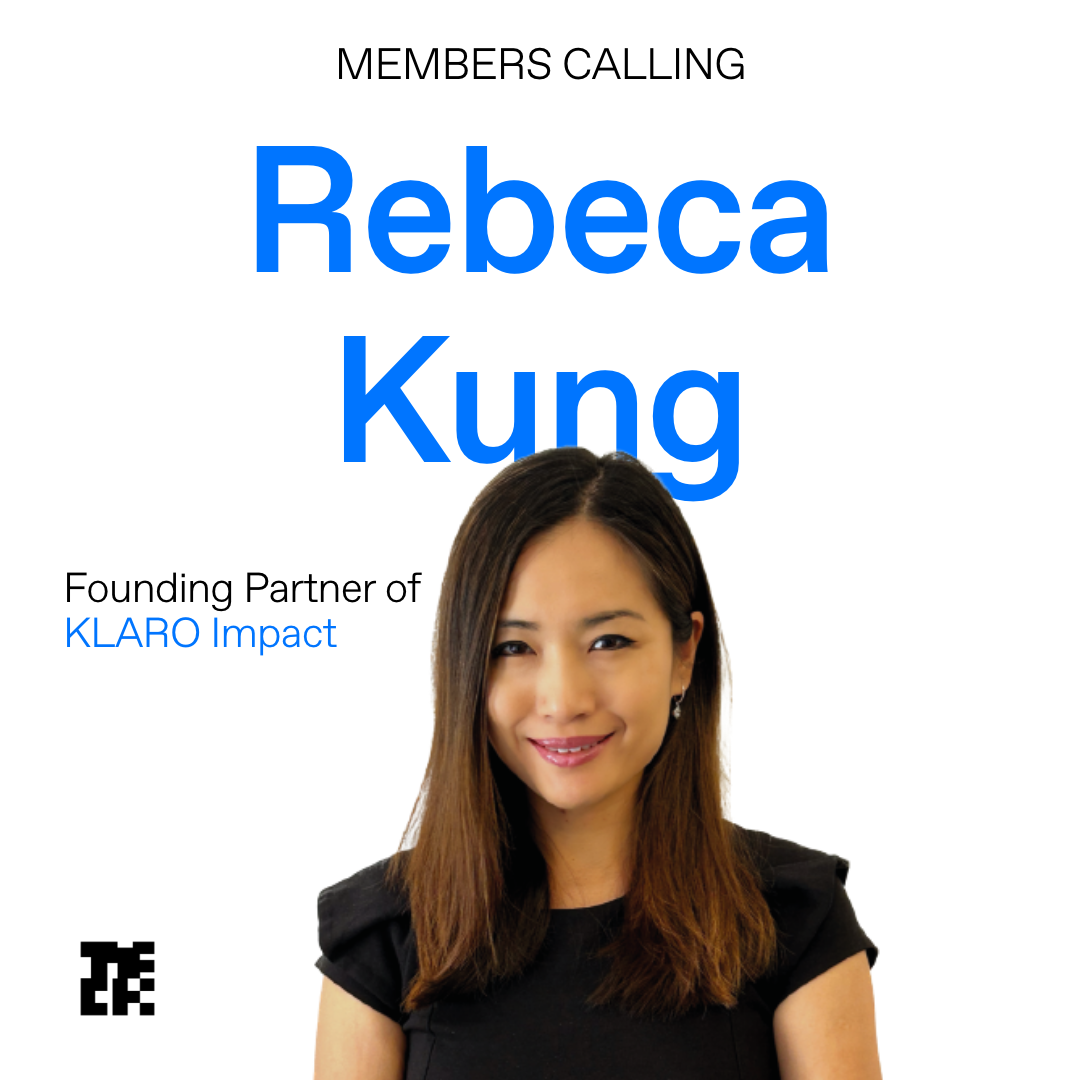
Rebeca Kung (Taiwan, 1982) wants capital to reach the people who are trying to change the world. She is the co-founder of KLARO Impact, a firm that helps impact-driven startups and organisations define their strategy, measure their results and attract investment. It also helps investors channel their capital more effectively towards projects that make a difference. Her background includes experience at McKinsey and Ship2B, as well as her own entrepreneurial journey.
In this interview, we discuss the turning points in her career, how money can become a force for progress, the potential of technologies such as AI and gene editing, and the decisions that lead us to change direction.
TB: What is the purpose of your project?
RK: To get more capital flowing towards solutions that address social and environmental challenges. We help organisations such as impact-driven startups and scaleups prepare to receive investment, and support impact investors in deploying their capital more effectively by bringing clarity and rigour to impact measurement.
TB: What stage is the project at, and where do you see yourself in two years?
RK: We’re about to celebrate our second anniversary, and we’ve already supported impact-driven startups across a wide range of sectors, including climate and the circular economy, education, the economic empowerment of young people in rural areas, culture and financial inclusion. We’ve helped them throughout the entire process, from defining their Theory of Change and measuring their impact to preparing investor materials.
Some of our clients have already secured funding, while others are currently going through active due diligence processes. In two years, we want to become the go-to partner for the impact ecosystem when it comes to strategy, measurement and fundraising, helping ensure that more and more capital generates positive impact.
TB: What has been the biggest challenge you’ve faced, and what did it teach you?
RK: Leaving an established career to pursue an MBA while raising a young child was my biggest challenge. It demanded far more time and energy than I had imagined. I learned that major changes are possible when you truly commit to them and know how to ask for support. That decision led me into strategic consulting, then entrepreneurship and, eventually, impact advisory.
TB: What’s the best advice you’ve ever received?
RK: “Be the subject of your own sentences.” In other words, take the initiative and make things happen rather than simply letting things happen to you. Be someone who drives change.
TB: Have you changed your mind about anything over time?
RK: I used to think that career and family were two paths competing with each other, and that having a child meant giving up part of my ambitions. I was wrong.
Becoming a mother gave me a greater sense of urgency and a deeper awareness of the long-term impact of our decisions. It also motivated me to pursue an MBA and start my own company. I now see life more as a portfolio of projects and experiences that we can shape in our own way.
TB: Who is a professional role model who inspires you, and why?
RK: Jacqueline Novogratz, founder of Acumen, whom I had the privilege of meeting at the Norrsken conference. She pioneered the concept of patient capital, supporting entrepreneurs in economically disadvantaged communities. She is an extraordinary example of how capital can become a force for progress.
TB: What do you value most in the people you work with?
RK: Motivation, excellence and integrity.
TB: Which technology will shape the future?
RK: Gene editing allows scientists to modify DNA with ever-increasing precision to improve medical treatments. Over the coming decades, this technology could cure numerous genetic diseases, improve cancer treatments and help develop crops that are more resilient to climate change.
Its potential is enormous, but it also raises fundamental questions about equitable access, safety and ethics. For example, where should we draw the line between treating a disease and enhancing human capabilities?
TB: Which startup or company will shape the future?
RK: I admire Khan Academy. It has used technology to make high-quality education freely accessible to anyone with an internet connection, and continues to evolve with AI-powered tutoring tools.
It’s a great example of how to scale impact, which is precisely what we help founders achieve at KLARO.
TB:What do you do to switch off?
RK: Play the piano or escape to the beach.
TB: A book you’d recommend.
RK: ‘Sapiens’, by Yuval Noah Harari. It explains how human beings are able to cooperate on a large scale through shared stories and beliefs. It’s an idea that deeply resonates with systems thinking: one of the most powerful levers for transforming reality is changing our beliefs. And changing the future starts with changing the story we tell ourselves about what’s possible.
TB: A song that captures your current stage in life.
RK: The ‘Habanera’ from Bizet’s opera ‘Carmen’. Although it was composed by a French composer, it’s inspired by Spanish culture and rhythms such as flamenco. In fact, it was this very piece that inspired me to take part in a university exchange programme in Spain.
TB: A recipe, a dish or a restaurant.
RK: Din Tai Fung, in Taiwan. In my opinion, they serve the best xiaolongbao in the world. Their excellence can be seen in every detail, from the folds of each dumpling to the customer service.
TB: A place in the world.
RK: Bhutan. It’s a spiritual and inspiring place, where the simplicity of everyday life contrasts with the noise and pace of the modern world.
TB: Where would you invest €100,000?
RK: In AI-powered civic education tools that help people understand how democracy works and access reliable, independent information. As AI transforms the way we consume information, we need technologies that strengthen informed and conscious civic participation rather than undermine it.
TB: If you weren’t an entrepreneur…
RK: I would probably work at a think tank, designing systems and policies that steer capital and artificial intelligence towards the common good and long-term thinking.
TB: What does Tech Barcelona mean to you?
RK: A vibrant ecosystem where ideas, determination, energy and capital come together.