Noticias
Petit Comitech | Pep Martorell and Luis Pareras, between fascination and wariness about AI
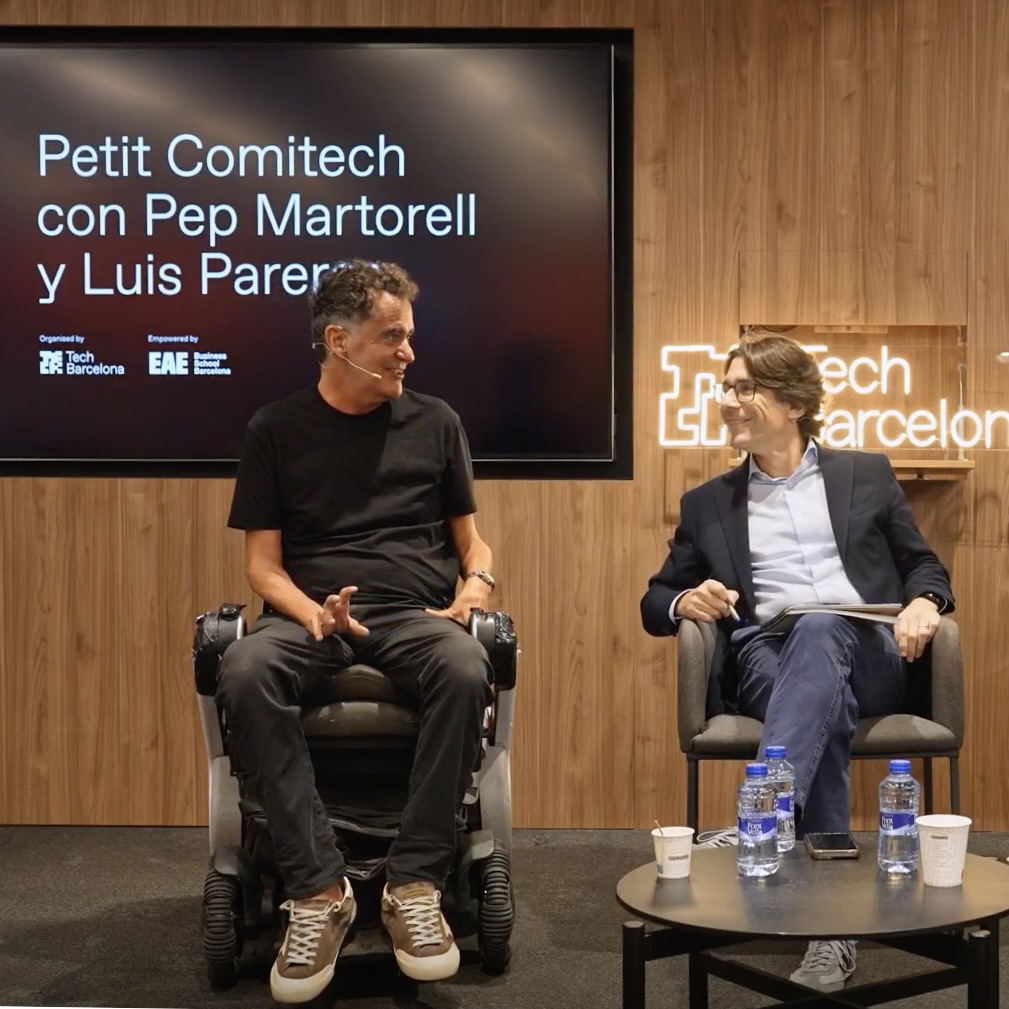
A physicist and a neurosurgeon. Two of the people who know the most about AI right now. Partners in a €100 million fund.
They disagree on the immediate effects this technology will have and how we should react. They agree that no one knows what is going to happen.
“The artificial intelligence models that are coming will surprise you,” says someone with access to tools that the rest of us mortals don’t have yet. Luis Pareras, neurosurgeon and founding partner of Healthequity and Invivo Partners, watches the AI race with a sense of wonder (and some fear): “trying to stop it will be impossible.”
Alongside him is Pep Martorell, a physicist, computer engineer and former associate director of the Barcelona Supercomputing Center, also amazed by the new capabilities, but with the caution of someone who has seen too many technological revolutions announced, and convinced that its adoption will be slower than we think.
Exactly one year ago, the two launched Invivo Ventures AI, a €100 million fund to invest in AI, science and deeptech startups. During the third edition of Petit Comitech, the exclusive series of meetings with technology leaders organized by Tech Barcelona and EAE Business School, they sought to shed light on what the future holds: where the risks and opportunities lie. There was also time for geopolitics and epistemological reflections, in a conversation “moderated” by Ignasi Costas, managing partner at RCD and secretary general of Tech Barcelona.
A risk no one voted for
Imagine that tomorrow Anthropic and OpenAI, the market leaders, decide to bias their models’ answers 1% to the left or the right. “The world would change and no one would have voted for it,” says Pareras. First risk: that a handful of companies end up shaping our future without us knowing how to govern them. And as long as we keep arguing over whether the chicken (AI) or the egg (governance) comes first, we will remain exposed to uncontrolled growth.
Back in 2023, thousands of experts signed an open letter calling for a six-month moratorium on the training of AI systems, allowing development to be slowed down and mandatory external evaluation frameworks to be implemented. This summer, 16 Nobel laureates signed the statement “We Must Act Now,” urging urgent preparation for the economic impacts of radically more powerful AI. And a few weeks ago, an Anthropic employee resigned, accusing the company of prioritizing the race over safety and fearing a threat to human life. “All it takes is for someone to break the moratorium for us to see a serious accident in the coming months,” warns Pareras. Only then will society react.
The problem, Martorell warns, is that “in this race, no one has an incentive to slow down if someone is chasing you from behind.” In China, for example, large open-source models are proliferating: “it’s not credible that they’ve come this far with second-hand GPUs from Jensen Huang,” he jokes. They actually start with commercial models, which they then ‘prune’ and ‘distill’ to create their own, tailored to their needs. While some are racing to avoid losing the lead, others are racing to catch up, and no one is taking their foot off the gas.
And what about Europe?
“Europe embarrasses me,” Pareras admits. On paper, the European system should be the best in the world. But the reality is that we live at the mercy of the models where productivity prevails. “We are always the first to regulate. If we don’t allow certain things here but they do in China or the United States, they move toward the future while we remain stuck in the Middle Ages.”
For him, the continent’s opportunity does not lie in developing foundation models, but in the application layer. That is where Invivo Ventures AI invests.
What are investors looking for?
Investors like Martorell and Pareras look for all those barriers to entry that prevent large companies from doing exactly what you do six months from now:
First. Proprietary data. If the data were public, the most advanced models would respond as well as or better than any entrepreneur. It is not enough for the data to be available for purchase, either.
Second. Unbeatable, hard-to-replicate know-how.
Third. Access to the market.
Fourth. Solutions to big or serious problems.
Fifth. Proactivity. In an environment where almost everything ends up being solved one way or another, taking the initiative will be rewarded.
AI will take our jobs. The question is when.
“AI already diagnoses an MRI better than a radiologist. It is a fact. And patients will be better cared for, which is what matters,” Pareras confesses. The way we understand work, not just that of radiologists, is going to be enormously affected. Because, when an AI does it better than you, what role is left for the human being? “We will have to reinvent the social contract, something that cannot be done overnight,” Pareras concludes.
Martorell, more cautious, finds it difficult to talk about predictions he cannot substantiate. “I find it hard to believe that all of this is going to happen. Everything is moving at a brutal speed. But the brutality comes from the speed of development, not the speed of adoption. We must take the ‘X factor,’ the human factor, into account. And humans, we are slow. Although many people make a living from the business of exaggeration [see our clickbait headline], for decades we have been talking about technologies that never quite arrive, because adoption remains the brake.”
Philosophising about AI
“I have been wrong my whole life about the brain,” in the words of a neurosurgeon. “I have always thought,” he continues, “that it is complex because life needs intelligence to emerge. But intelligence itself is simple: zeros and ones, connections. We are a machine. A biological machine. It is thought that human consciousness is the only form of consciousness. But what tells you that an AI is not conscious? We will never know. But we can be sure that they will behave as if they were conscious.”
Martorell, at that moment, to the fund’s investors who were present in the CaixaBank All in One room: “Don’t worry, we work too.”