Noticias
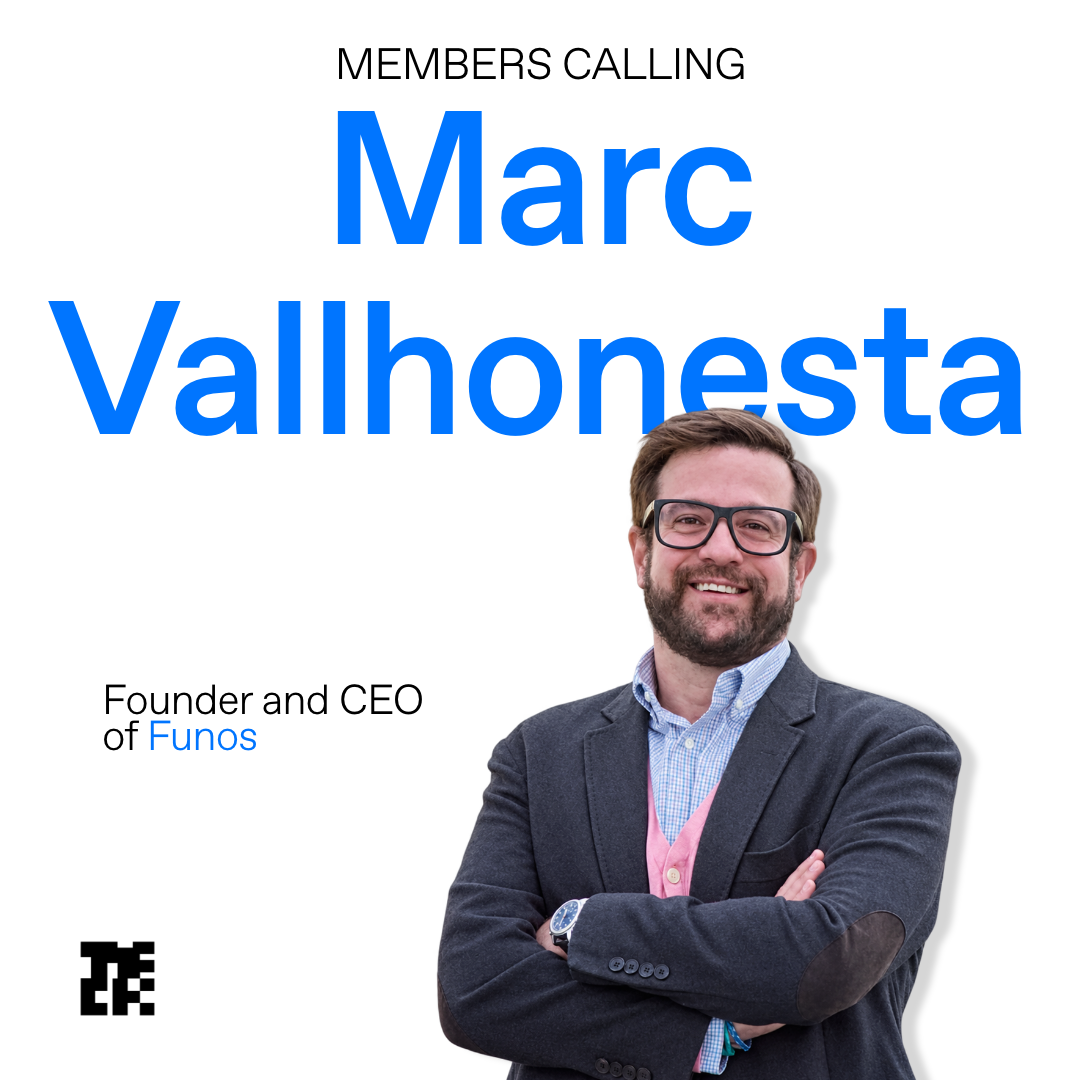
Members Calling #172 | Marc Vallhonesta: “How can a sector that we will all use one day have gone decades without changing?”
Since humans have been human, we’ve always looked for ways to say goodbye to the people we love. Rituals, customs and ways of experiencing grief vary from one culture to another, but one thing remains the same: saying goodbye to someone is never easy. Even less so when, in the middle of the pain, you also have to deal with arranging a funeral.
Paperwork, quotes, payments, decisions, phone calls, questions… A long list of things to take care of at precisely the moment when the last thing you want to do is deal with anything.
Out of this reality, which few people talk about but many experience, came Funos, the funeral services comparison platform founded and led by Marc Vallhonesta (Barcelona, 1978). Its goal: to bring technology to a traditionally static sector and help families navigate a process that can be particularly tedious.
TB: What is the purpose of your project?
MV: I’ve always found it difficult to accept situations where people have to make important decisions with so little information, so little transparency and without being able to make those decisions freely. That’s where we saw an opportunity to build a business, but also to address a situation that had never seemed fair to us.
At Funos, we want to change that. We’re building a brand that brings transparency, clarity, empathy and professionalism to the sector — ultimately empowering users through technology. We want to build the technological infrastructure that allows anyone to research, compare, book and manage everything related to the end of life with the same ease and transparency with which we book a hotel or buy anything online.
TB: Where is the project today, and where do you see it in two years?
MV: We’ve validated the model, achieved profitability and now it’s time to scale. We operate across Spain, with agreements with more than 750 funeral homes and funeral parlours, and we continue to add new services around the end of life.
In two years, I’d like Funos to no longer be known simply as a comparison platform, but as the sector’s go-to platform, combining a marketplace, software, AI and data to connect families, funeral homes, insurers and public administrations. We also hope to have started our international expansion.
TB: What key decision has shaped your project?
MV: Choosing a huge market precisely because nobody wanted to enter it. When we started, many people asked us why funerals. For me, the question was the opposite: how is it possible that a sector we will all use one day has barely changed in decades?
I’ve always been drawn to markets where consumers feel powerless, have little information and limited ability to make decisions. I believe technology should help people make their own choices freely. The funeral sector was probably one of the best examples of this. We saw a huge opportunity to create value.
We’ve always prioritised knowledge over volume. We’ve chosen to grow sustainably, specialising and working with clients where we can create real value.
TB: What has been the biggest challenge you’ve faced, and what has it taught you?
MV: Building a business in a sector where trust is much more important than technology. You can build the best product in the world, but if you can’t build credibility with families and professionals, it’s worthless.
I’ve learned that innovation isn’t just about developing technology; it’s about getting people to want to use it. Innovation only makes sense when it solves a real problem.
TB: What’s the best advice you’ve ever received?
MV: I love surrounding myself with people who are better than me, asking for their opinions and listening to their advice. I ultimately make my own decisions, but I believe a good conversation can save you months of mistakes.
If I had to choose just one piece of advice, it would be this: sell before you build. Until someone voluntarily pays for your product, you only have a hypothesis.
TB: We all change over time. Have you changed your mind about anything?
MV: I used to be more idealistic and thought that a great idea was the most important thing. Today, I still believe in ideas, but I’ve learned that what really makes the difference is the team behind them and the execution: people with passion, resilience and the ability to execute, who care about the details, surround themselves with the best and never lose sight of the financial reality of the business. Today, I’m still just as idealistic, but much less naive.
TB: A professional role model who inspires you.
MV: I’ve been lucky enough to learn from many people. To name a few, Urs Rothmayr and Mathieu Carenzo have taught me to question things and think differently.
TB: What do you value most in the people you work with?
MV: Honesty. I’d rather work with someone who challenges me with good arguments than someone who always agrees with me. Commitment and loyalty are also very important.
TB: A technologyy that will shape the future.
MV: Robotics. We’re obsessed with digitising software, but there are still countless physical jobs that will change radically over the coming decades.
TB: A startup or company you admire, and why.
MV: A startup or company you admire, and why.
TB: What do you do to switch off?
MV: Going away for the weekend with my family, going out with friends, walking, cooking, and spending time on things like DIY or gardening.
TB: A book to recommend.
MV: Hablando en Plata, by Mathieu Carenzo. It debunks many myths about entrepreneurship and reminds us that building a company is, above all, about selling, executing and generating cash. And most importantly, it tells it like it is, without sugar-coating anything, based on real cases.
TB: A song that captures where you are in life right now.
MV: ‘Viva la Vida’, by Coldplay.
TB: A recipe, a dish, a restaurant.
MV: I love cooking and bringing family and friends together around the table. It’s probably one of the things I enjoy most. And if there’s one type of dish I particularly love, it’s rice dishes.
As for restaurants… I’d never be able to choose just one. Wherever I go, I keep memories of great restaurants I’d love to return to.
TB: A place in the world.
MV: The United States, and more specifically California and the major cities on the East Coast. Although it’s far from perfect, I’m fascinated by its extroverted nature, openness, entrepreneurial, hardworking and innovative spirit, as well as the sense of freedom you feel there.
I could happily live in Miami, New York or San Francisco.
TB: Where would you invest €100k?
MV: Half in Funos. The other half in startups led by exceptional founders.
TB: If you weren’t an entrepreneur…
MV: I’d do something related to marketing and consumers. I’d probably open a restaurant (which would still mean being an entrepreneur!) and continue teaching.
I’m passionate about understanding people, designing exceptional consumer experiences and solving real problems that have a positive impact on people’s lives
TB: What does Tech Barcelona mean to you?
MV: Tech Barcelona is much more than an association, its members or its spaces. It has managed to build an ecosystem, create connections between the people involved, influence public and private institutions, and promote Barcelona’s entrepreneurial movement around the world.
It has shown that when you genuinely connect entrepreneurs, investors, corporations and institutions, the result is much greater than the sum of its parts.