Noticias
Members Calling #178 | Elisenda Bonet: “We want to prevent premature babies from having to take on functions they are not yet ready for”
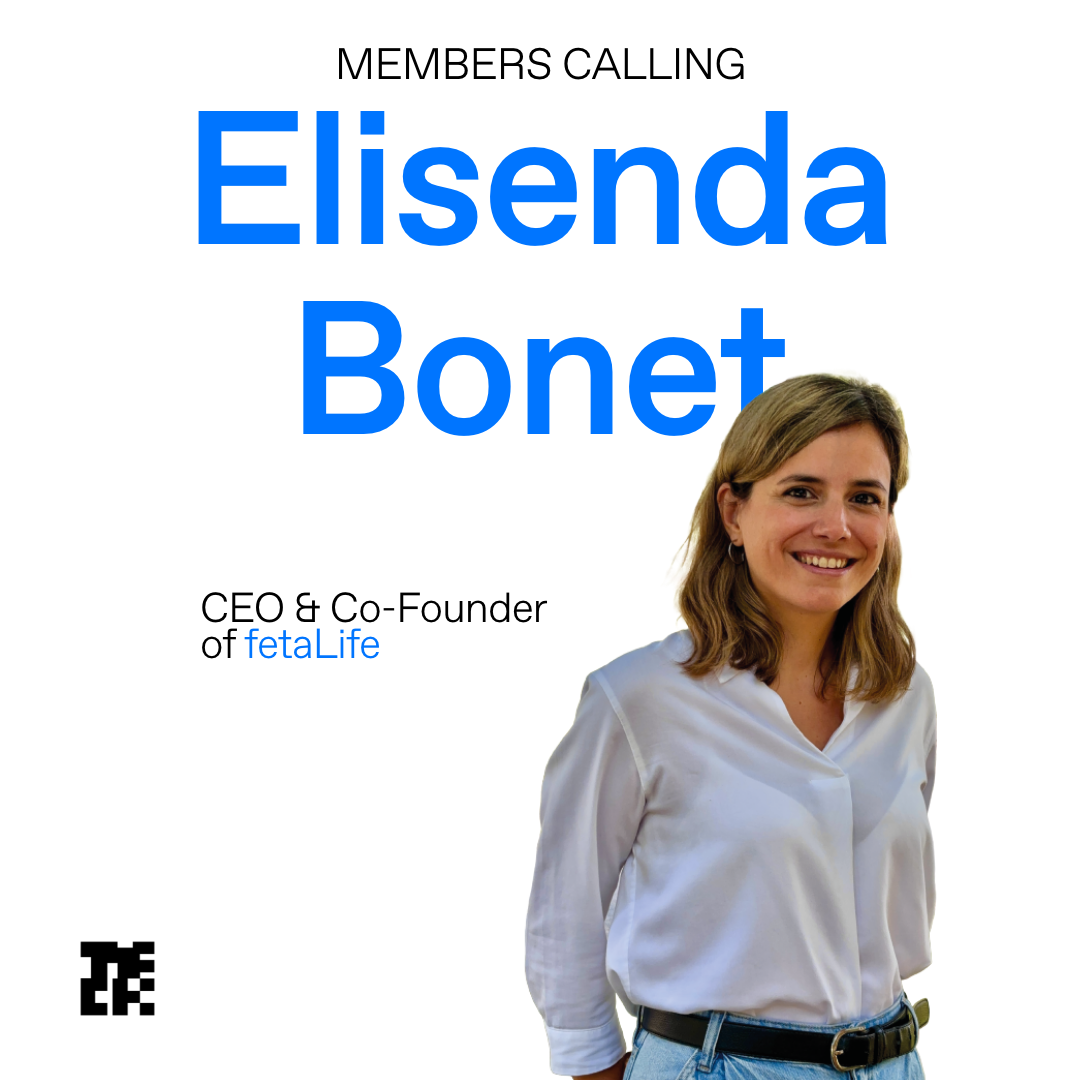
Every year, 666,000 babies are born before 28 weeks of gestation, facing the risk of respiratory, neurological or digestive complications that may affect them throughout their lives. “They suddenly have to take on functions they are not yet ready for,” explains Elisenda Bonet (Bages, 1984), CEO and co-founder of fetaLife.
With more than €11 million in funding, fetaLife is developing a liquid fetal incubator that recreates the conditions of the mother’s womb. Through an artificial placenta connected to the umbilical cord, it enables the exchange of oxygen and nutrients to be maintained, allowing extremely premature babies to continue developing.
Beyond fetaLife, Elisenda talks to us about the decisions that have shaped her career, her scientific role models, and the importance of building a team capable of achieving far more together.
TB: What is the purpose of your project?
EB: At fetaLife, we are developing a liquid fetal incubator for extremely premature babies, particularly those born between 22 and 26 weeks of gestation, when their organs are not yet ready to function outside the mother’s womb.
Our technology aims to maintain fetal physiology for longer by recreating a liquid environment and using an artificial placenta connected through the umbilical cord to facilitate the exchange of oxygen and nutrients. The idea is to prevent these babies from suddenly having to take on functions they are not yet ready for.
What we want is to give them more opportunities to develop under better conditions. Because it is not just about survival, but about reducing the complications that can affect them throughout their lives.
TB: What stage is the project at, and where do you see yourself in two years?
EB: We have achieved highly significant preclinical results, including maintaining fetal support for 21 days in an experimental sheep model. We are now focused on turning these results into a safe, reproducible technology that is ready to meet regulatory requirements.
In two years, our goal is to be ready to initiate the first-in-human study, having completed the necessary scientific, technical and regulatory steps. We have an ambitious timeline, but we are clear that, with a technology of this potential and responsibility, rigour and safety must always come first.
TB: What was a key decision that shaped your project?
EB: One key decision was to approach the project from the outset as a technological development aimed at reaching hospitals and patients, rather than simply as a research project. This has allowed us to move towards technology transfer and build a team with the capabilities needed to turn scientific results into a real technology.
We were also clear that we did not want to develop a solution that only a few highly specialised and well-resourced hospitals could adopt. That is why we designed the liquid incubator with integration into public healthcare systems in mind, aiming to make it possible for hospitals to incorporate it without having to completely transform their facilities, and to ensure that cost does not become an insurmountable barrier.
This vision shapes many of the decisions we make, but it is fundamental to us: we do not simply want to develop an innovative technology; we want to ensure that, when it is ready to reach patients, it can benefit as many babies as possible.
TB: What has been the biggest challenge you have faced, and what has it taught you?
EB: fetaLife is a “project of projects”. It is not just about building an incubator, but about developing practically everything it needs to function: the liquid that recreates the amniotic environment, the cannulas, the monitoring systems, the clinical procedures… Many of the solutions we needed simply did not exist.
The biggest challenge is getting all these components, each with its own complexity, to work together safely, reliably and in a coordinated way. This requires connecting very different disciplines and making progress on many fronts at once.
Above all, this experience has taught me the value of building a multidisciplinary team and trusting each person’s expertise. We are fortunate to have a great deal of talent and a healthy ambition that pushes us to go a little further every time. We constantly learn from one another, and I have seen how this combination of knowledge, trust and the desire to improve enables us to tackle challenges that would be very difficult to achieve individually.
TB: What is the best advice you have ever received?
EB: Surround yourself with the best possible team: people who know how to do things you do not, who bring different perspectives and who can propose solutions you would never have imagined yourself.
It sounds like a cliché, and when you first hear it, you might think, “Yes, yes, we already know that.” But over time, you realise that it goes far beyond bringing together different technical skills or professional experiences. It is about sharing a vision and enthusiasm for a project, and understanding that this energy does not always come from the same person: there are moments when some people push harder, while at other times others bring new ideas, confidence or the strength to keep going.
A diverse team multiplies the ways of getting where you want to go. It allows you to see paths you would never have imagined individually, adapt to obstacles and find solutions that would otherwise be impossible.
In a project as complex as fetaLife, where you have to make progress in many areas at once and face challenges no one has solved before, this is essential. It is not just about having the best talent, but about building a team that, together, can go much further than any individual could alone.
TB: Have you changed your mind about anything over time?
EB: In everything and in nothing. At the core, my vision remains the same: to develop technological solutions that can transform people’s lives. What has changed radically is how to achieve that.
I am an inquisitive person. I like moving quickly and finding solutions. But over the years, I have learned that you cannot always have an immediate answer or result, nor is it always advisable. Some decisions and processes need time, reflection and input from all the stakeholders involved. You also need to give people space to understand different points of view, question their own ideas and find new ways of doing things.
It is not about slowing down, but about knowing when to run and when to stop and think. I have learned that moving quickly does not always mean arriving sooner, and that sometimes taking more time to make the right decision is what allows you to go further.
TB: Un referente profesional que te inspire y por qué.
EB: Ingrid Daubechies, a mathematician best known for her contributions to wavelet theory, a set of mathematical tools that are fundamental to signal and image processing and compression.
When we study engineering, we constantly use equations and tools named after people like Euler, Laplace or Fourier: almost always men and often long dead. When I was working on my final degree project, I used wavelets and Daubechies filters to process medical images. As I explored them in greater depth so I could explain them properly, beyond the formulas, I discovered that behind that name was a woman mathematician—and a contemporary one at that.
That discovery opened my eyes: science is not just what we read in books and learn from the past. It is living knowledge that continues to evolve, and we can also be part of it. I was particularly struck by how fundamental mathematical research can end up having applications across very different fields.
As for people closer to home, I would say everyone in general and no one in particular. Colleagues, friends… I believe everyone has something that can inspire or teach you. I try to learn from everyone.
TB: What do you value most in the people you work with?
EB: Commitment, curiosity and generosity. And, above all, that they are good people. I like working with people who have their own judgement, who question things, contribute ideas and also know how to listen and learn from others.
At fetaLife, we are people with very different backgrounds, experiences and ways of thinking. When you work with such diversity, I believe it is essential to start from a place of trust: knowing that everyone is a good person, fully committed and wants to contribute to the best possible outcome.
This trust is especially important when opinions differ. If you are certain that everyone is giving their best and that disagreements come from wanting to move the project forward, rather than from personal ego, it becomes much easier to listen, question your own ideas and find the best solution together.
TB: What technology will shape the future?
EB: Technologies capable of maintaining or supporting vital functions outside the human body.
I believe we will see technology take us beyond current biological limits, not to replace the human body, but to support it when it needs help the most. For example, by keeping organs alive outside the body so that the treatments they need can be applied to them.
This is a field that is only just beginning to be explored and, despite its current limitations, it could radically transform medicine and open up new ways to save lives. Some of these advances, which until recently seemed like science fiction, are increasingly close to becoming reality.
TB: A startup or company that will shape the future.
EB: The Smart Lollipop. I admire ideas that, although they seem very simple, can solve real problems and improve people’s lives. Anyone who has had children can immediately understand the value of a lollipop that allows saliva samples to be collected for medical diagnosis in a gentler and less invasive way for children.
Behind this simplicity, I believe, lies a great deal of innovation and a long development process. It is a good example of how an idea that everyone can understand may require years of work to become a real medical solution. It also shows how bringing an innovation to market, especially in healthcare, can be much slower than we would like.
TB: What do you do to switch off?
EB: With three children and a dog who joined the family a few weeks ago, there is always something going on at home! I enjoy going to the mountains, cooking and spending time with family and friends. I am not someone who likes sitting still: I switch off by changing activities, doing different things and enjoying the little moments with the people I love.
TB: A book you would recommend.
EB: ‘Lessons in Chemistry’, by Bonnie Garmus. I like the way it combines science, critical thinking and a very insightful perspective on the role of women in society. It is a story that challenges conventions, champions independent thinking and shows how daring to think differently can open up new paths. I also like that it does so with humour, without losing sight of the importance of science.
TB: A song that defines your current stage in life.
EB: “A Sky Full of Stars”, by Coldplay. It reflects a stage in life full of energy, enthusiasm and a desire to do things. Despite the challenges, I try to maintain this optimistic outlook and enjoy the journey, not just the destination.
TB: A recipe, dish or restaurant.
EB: A recipe: spaghetti carbonara. A classic that, when done well, is hard to beat. No complications, just good ingredients!
A restaurant: L’Osteria del Contadino, an Italian restaurant I really like. Otherwise, any restaurant that cooks with good olive oil and quality ingredients. That said, with three little ones, the restaurants that are currently a hit at home are the ones they like: a good burger or a revolving sushi bar.
TB: A place in the world.
EB: Barcelona. I am from Manresa, and I have had international experiences that have taught me a great deal, but they have also made me appreciate what we have here.
Barcelona is an exceptional platform. We have hospitals, universities, research centres, companies and a great deal of talent concentrated in one place. Sometimes we are not fully aware of how much we can achieve from here.
TB: Where would you invest €100,000?
EB: In a talented team with a purpose worth pursuing. For me, these two things must go hand in hand.
I would look for people who know the problem they want to solve very well, who are committed to it and who have the ability to work together, learn and adapt. People with sound judgement, generosity and perseverance, capable of bringing together different perspectives and moving forward even when the path is unclear.
A good idea is important, but it is the people and their conviction in pursuing it that can turn it into reality. And if what they build can also improve people’s lives, even better.
TB: If you were not an entrepreneur…
EB: I would probably be driving some other initiative. I really enjoy getting things started, connecting people and finding ways to move ideas forward. I do not know exactly which sector it would be in, but I find it difficult to imagine myself in a job where I could not build something and actively contribute.
TB: What does Tech Barcelona mean to you?
EB: A community that connects people with very different experiences, knowledge and perspectives, but with a shared desire to make things happen. I particularly value the opportunity to share challenges with other entrepreneurs, learn from their experiences and build connections beyond our own sector.
I believe it is precisely from these unexpected connections that new ideas, collaborations and opportunities can emerge—opportunities we would hardly find if we were all working on our own.